


(REject Duplicated) Why Bitcoin Doesn’t Feel a Bull Market

Imagine I told you I created a technology that could revolutionize finance and governance.
As the #1 competitor in a $100 trillion dollar currency market, it has a massive first-mover advantage. Thousands of developers use its technology and several VC heavyweights have launched new ventures to bring it more value, utility, and positive attention.
China and the Marshall islands are using spin-offs of this technology to implement their monetary policy.
Adoption has grown steadily for years, sometimes exponentially, yet still reaches maybe only 5% of the human population. Facebook, Microsoft, Ernst & Young, IBM, Walmart, and JP Morgan are using this technology to develop new products and services for their clients.
Oh, and I forgot, its price has gone up for five of the last six years (including this one). Since inception, its value has grown over one million percent. Over the past 12 months, its price has doubled.
Wouldn’t you want to invest in this technology?
Nope. It’s going to zero.
When you look back and see last year's drop from $14,000 to $6,500, it makes more sense why people seem skeptical.
We're down a lot from $14,000. For over half a year, the price has struggled to get anywhere near it, going as high as $10,000 before crashing.
Far short of the mark.
Most recently, bitcoin dropped down to $8,500 before bouncing up again. Now, many headlines said the price will go lower, some suggestion $7,900 while others speculating $6,500 again.
If this happens (it’s a big if), bitcoin’s price chart will look like this:
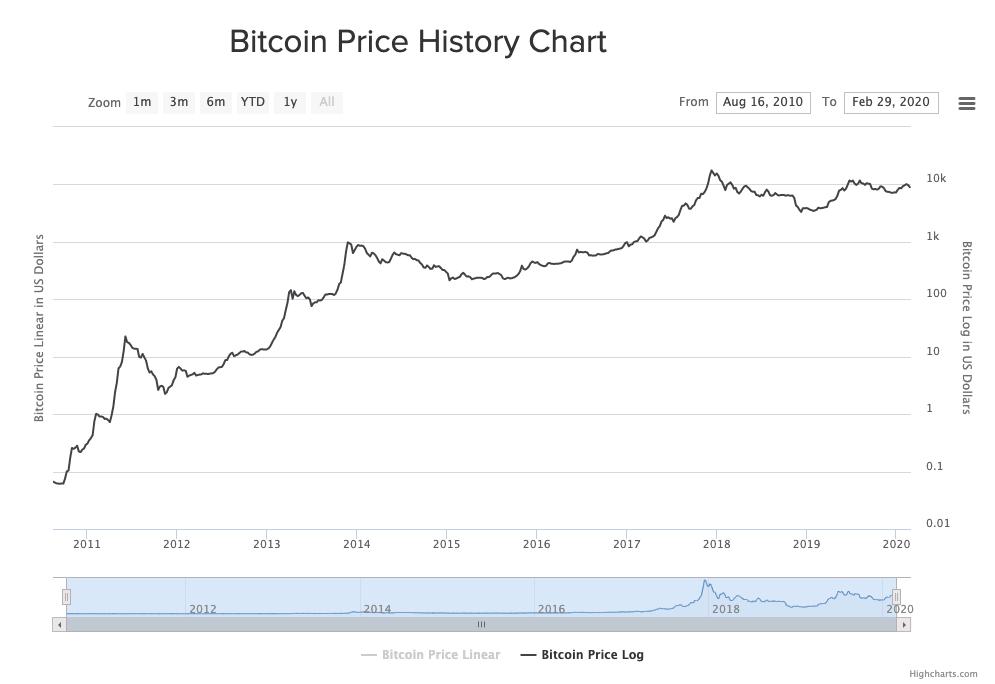
That's bitcoin’s price since 2010, assuming price goes down to $7,900 or $6,500 sometime soon.
Does that look like a distressed asset stuck in a bear market?
What if we zoom in to the most recent 15 months, the time since our last bear market ended?
Let's assume we do go down to $7,900. Here's what the chart will look like:
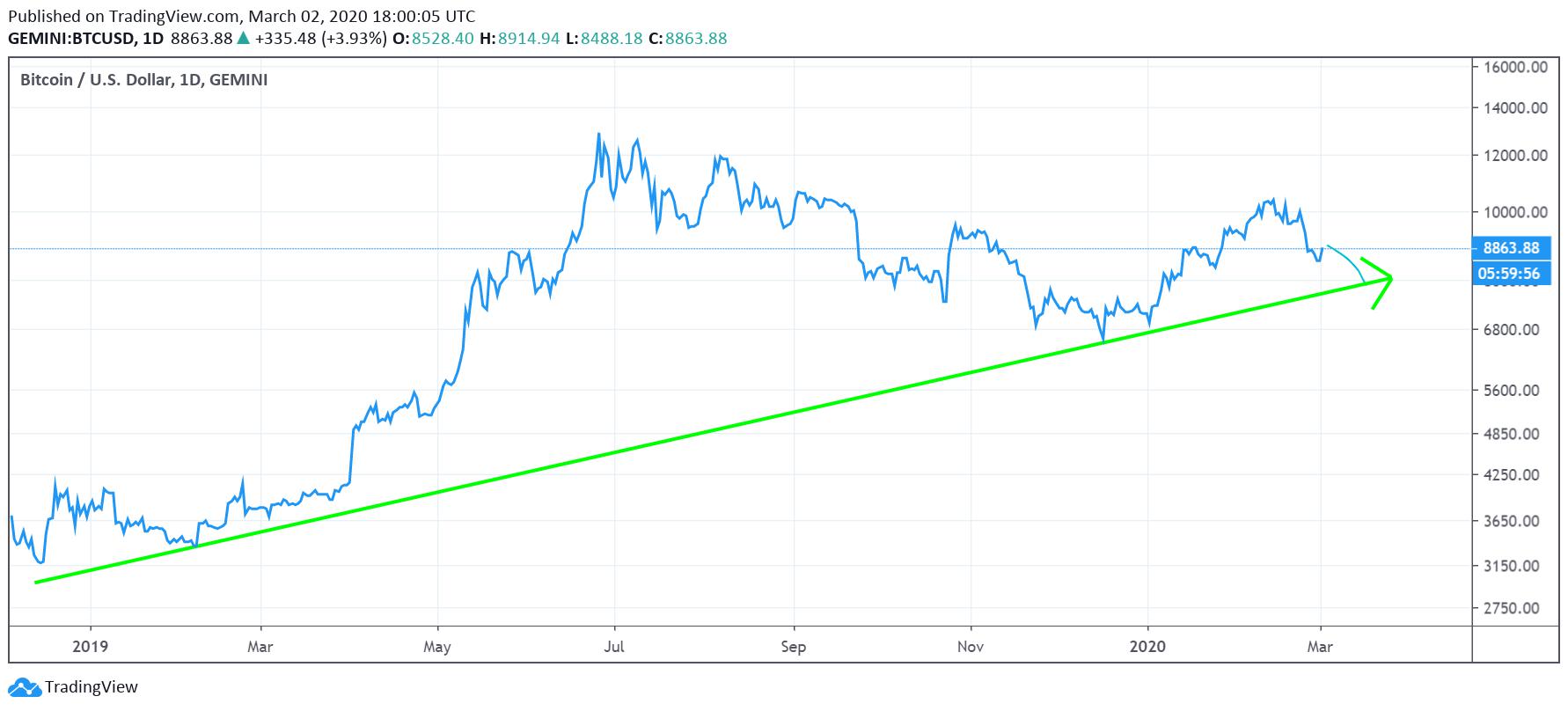
Even if bitcoin's price goes down to $7,900, the trend is clear.
Price keeps going up.
Not straight up, of course. But how can anybody look at that chart and see anything other than a bull market?
But it doesn’t feel like a bull market . . .
Bull markets always start like this. Do you remember when the U.S. stock market went up 40% in one year? No?
That makes sense. It happened in 2009, at the end of the Great Recession.
At the time, few people realized that would kick off an 11-year bull market. Expert analysts called for crashes for years after that momentous upswing. Some still do.
(Though, in fairness, this time they may be right.)
Sometimes it takes a while to sink in.
To be sure, I’m not suggesting we will get an 11-year bitcoin bull run.
As I explain to subscribers of my Crypto is Easy newsletter, we could see a crash to $5,500 and remain in a bull market.
But when you see a drop from $14,000 to $6,500, and now another drop from $10,500 to who knows where - it's no wonder people are still scared.
That massive 2018 crash is still fresh in people’s minds.
Volatility does not mean a bear market
If you want that $1 million bitcoin everybody dreams about, you have to accept massive crashes along the way.
Some crashes are setbacks, others cause actual bear markets. We have had a setback this year, but that does not mean the bull market has ended.
Expect higher prices. And crashes. And, eventually, a bear market.
Just not yet.
Image via Shutterstock