


How Provably Fair Algorithms Are Redefining Bitcoin Roulette and the Future of Crypto Casinos


Online gambling has always relied on trust. Players deposit money, spin the wheel, and assume that the result is random — even though they have no direct way to confirm it. Behind every virtual table sits a random number generator that determines outcomes, but these systems are opaque by design.
That’s changing rapidly. Blockchain technology is replacing blind trust with mathematical proof. In the emerging world of crypto casinos, every spin, card, and bet can be verified through cryptographic algorithms known as provably fair systems.
The clearest example of this innovation is bitcoin roulette — a blockchain-powered version of roulette that allows players to confirm each spin’s fairness independently. This approach is transforming how online casinos operate, how regulators think about compliance, and how players understand transparency itself.
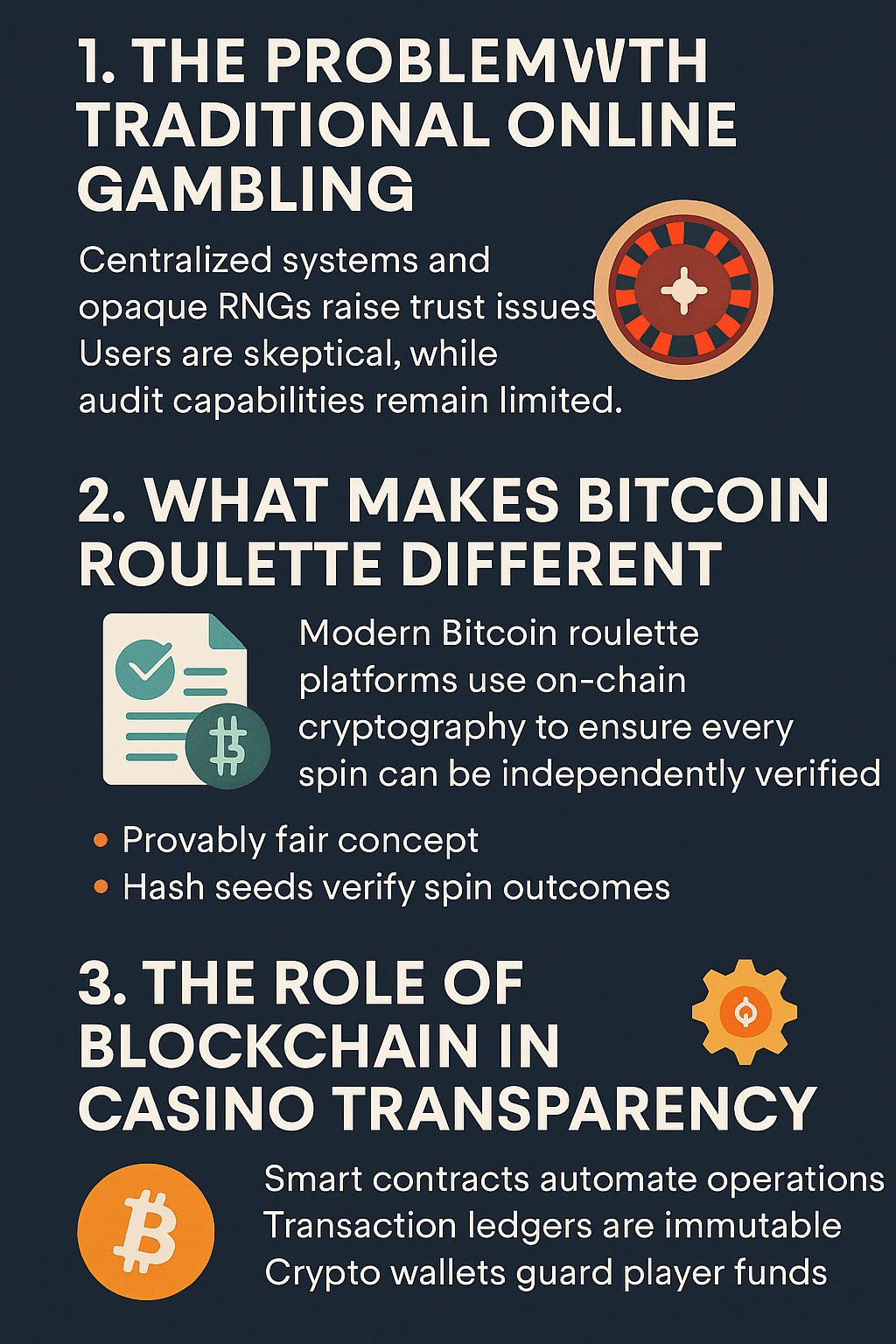
1. The Problem with Traditional Online Gambling
Traditional online casinos are centralized environments. The game code, RNG, and result generation all run on private servers controlled by the operator. Even when licensed or audited, players can’t verify fairness on their own.
Typical limitations include:
-
Closed RNG systems: The randomization logic is hidden.
-
Audits based on samples: Certifications test general fairness, not every outcome.
-
No user verification: Players must trust that the casino didn’t manipulate results.
The system works, but it’s opaque. Once a player clicks “Spin,” the outcome appears — and that’s where transparency ends.
2. What Makes Bitcoin Roulette Different
Bitcoin roulette flips this model entirely. It introduces shared randomness and cryptographic accountability, giving both player and operator equal participation in determining the spin.
Here’s the process behind a provably fair roulette system:
-
Server seed: The casino generates a random string of characters (the seed) and publishes a hashed version before gameplay.
-
Client seed: The player’s browser generates its own seed locally, invisible to the casino.
-
Nonce: A counter increments with each spin to keep every round unique.
-
Combination: The three values (server seed, client seed, nonce) are hashed together using an algorithm such as SHA-256.
-
Verification: Once the casino reveals its original seed, players can verify that the hash matches the one published earlier.
This structure prevents both sides from altering the outcome. The casino can’t change its seed mid-game, and the player can verify that the spin was mathematically fair.
The concept is simple: the randomness is provable, not just claimed. It transforms roulette from a closed game of chance into a transparent mathematical process.
3. Blockchain as a Transparency Layer
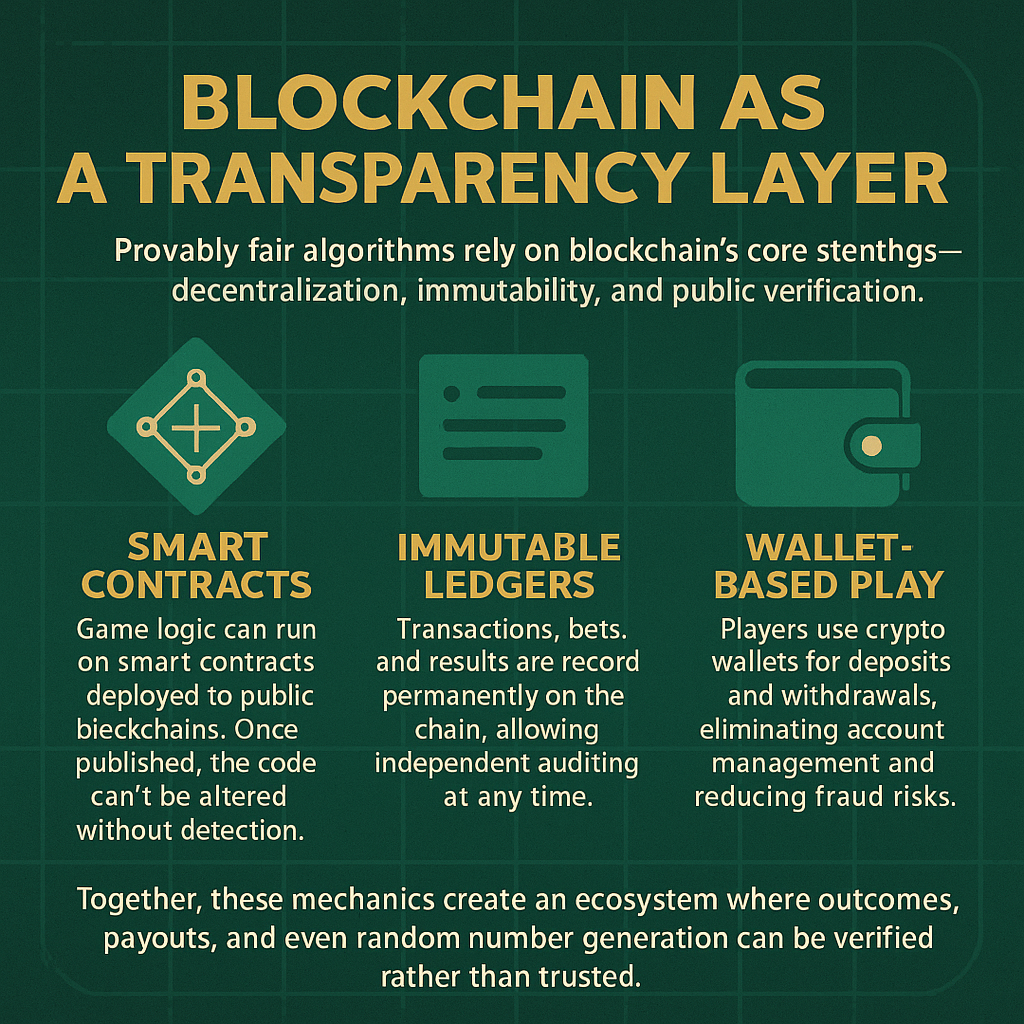
Provably fair algorithms rely on blockchain’s core strengths — decentralization, immutability, and public verification.
-
Smart contracts: Game logic can run on smart contracts deployed to public blockchains. Once published, the code can’t be altered without detection.
-
Immutable ledgers: Transactions, bets, and results are recorded permanently on the chain, allowing independent auditing at any time.
-
Wallet-based play: Players use crypto wallets for deposits and withdrawals, eliminating account management and reducing fraud risks.
Together, these mechanics create an ecosystem where outcomes, payouts, and even random number generation can be verified rather than trusted.
4. Why Players Are Switching to Crypto Casinos
Beyond transparency, Bitcoin and blockchain gaming solve many of the friction points in traditional online gambling.
These benefits have helped crypto casinos grow steadily among both casual players and professionals seeking transparent, data-driven gameplay.
5. The Mathematics Behind Provably Fair Systems
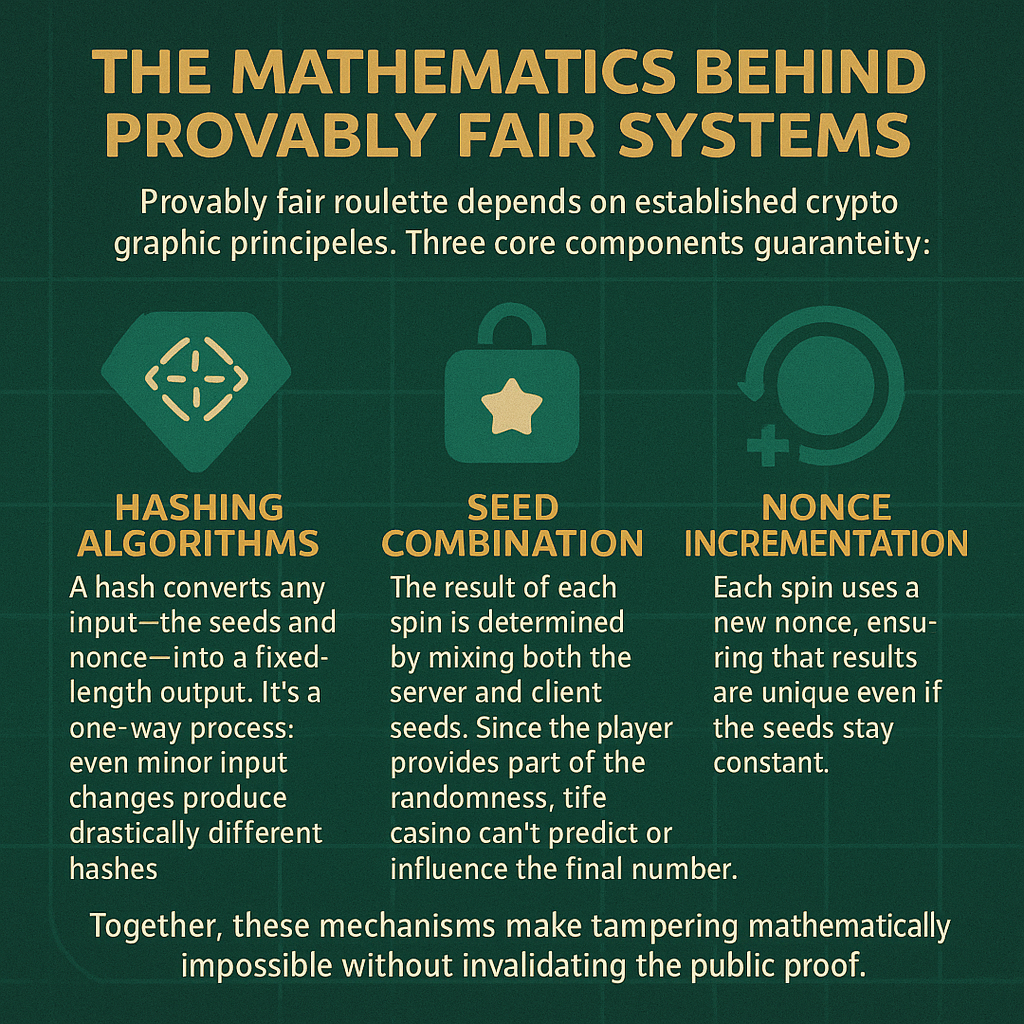
Provably fair roulette depends on established cryptographic principles. Three core components guarantee integrity:
-
Hashing algorithms: A hash converts any input — the seeds and nonce — into a fixed-length output. It’s a one-way process: even minor input changes produce drastically different hashes. Because the casino publishes the hash before revealing its seed, players can verify after the spin that the output couldn’t have been changed retroactively.
-
Seed combination: The result of each spin is determined by mixing both the server and client seeds. Since the player provides part of the randomness, the casino can’t predict or influence the final number.
-
Nonce incrementation: Each spin uses a new nonce, ensuring that results are unique even if the seeds stay constant.
Together, these mechanisms make tampering mathematically impossible without invalidating the public proof.
6. Compliance and Auditing Implications
Provably fair systems have practical consequences for regulators and auditors. Because every game result is reproducible and timestamped, auditing shifts from trust-based to evidence-based.
Potential benefits include:
-
Automated oversight: Regulators can run hash verification scripts instead of sampling results.
-
Reduced disputes: Players can self-verify outcomes, minimizing chargebacks and complaint volumes.
-
Lower audit costs: Proofs exist natively in the game data — no separate certification cycle needed.
This also benefits operators. A provably fair design can serve as continuous proof of honesty, simplifying licensing renewals and building measurable player trust.
7. Technology Integration in Bitcoin Casinos
Provably fair roulette is part of a broader crypto-casino architecture where game logic, funds, and transparency merge into one ecosystem.
-
Smart contract backends ensure consistent rule enforcement.
-
Stablecoin support (USDT, USDC) allows fixed-value betting without volatility.
-
Lightning Network integration makes micro-bets and instant settlements viable.
-
Cross-chain bridges enable deposits from Ethereum, Solana, or Polygon with identical verification processes.
This flexibility lets developers build entire casino ecosystems where each game — not just roulette — is provably fair and interoperable across blockchain networks.
8. Economics of Verifiable Fairness
Transparency changes the incentives for both operators and players.
Instead of competing on slogans like “trusted” or “certified,” casinos can compete on provable performance.
9. Beyond Roulette: The Expanding Use of Provably Fair Systems
The same structure that powers Bitcoin roulette now supports multiple genres:
-
Dice and crash games: Immediate outcomes make verification easy and instant.
-
Blackjack and poker: Seeds determine deck order, ensuring fair shuffles.
-
Slots: Spin sequences derive from combined seeds and nonces rather than local RNGs.
As these mechanics become standard, players will expect verification options by default — much like SSL certificates became standard for secure websites.
10. Future Outlook: Decentralized and DAO-Based Casinos
The next phase of gambling innovation will move from provably fair games to provably fair platforms. Decentralized casinos governed by DAOs (Decentralized Autonomous Organizations) will use governance tokens for rule-setting, staking, and reward distribution.
Future directions include:
-
DAO-controlled house edges and payout rates.
-
Community voting on new game releases.
-
Cross-chain fairness verification through standardized proof protocols.
-
VR integration, showing live hash verification next to each roulette wheel in virtual environments.
These developments extend blockchain’s core purpose — transparency and decentralization — into the very structure of casino ownership.
11. Responsible Innovation
While provably fair gaming ensures honest outcomes, it doesn’t eliminate gambling risks. Operators still need robust self-exclusion, deposit limits, and transparent KYC/AML controls for legal compliance.
Technology makes games provable; policy ensures they remain ethical.
Conclusion
Provably fair algorithms are redefining the relationship between casinos, regulators, and players. By combining cryptographic hashing, player-seeded randomness, and blockchain transparency, Bitcoin roulette has become a working model of what truly verifiable gaming looks like.
It replaces promises with proof — a shift likely to influence every area of iGaming, from licensing standards to player expectations.
As adoption grows, “fairness” will no longer be a marketing term but a measurable property of the code itself.