


XMR to SOL: Moving From Monero Into the Solana Ecosystem

XMR to SOL is a relatively uncommon direct pair. Many platforms support Monero or Solana separately, but far fewer offer a straightforward wallet-to-wallet route between them.
Non-custodial instant swap services are the main practical option for users who want to move from Monero into the Solana ecosystem without opening an exchange account.
Settlement time is driven largely by Monero confirmations and is typically measured in tens of minutes rather than seconds.
Disclaimer
This article is for informational purposes only and does not constitute financial, investment or legal advice. Cryptocurrency involves risk of loss. Pair availability, rates, limits and compliance behaviour change. Always verify the live interface before sending funds.
Last reviewed: September 2026.
Table of Contents
- Why Move From Monero to Solana?
- Why XMR to SOL Is a Rare Direction
- Which Services Support XMR to SOL?
- How Long Does an XMR to SOL Swap Take?
- How the Swap Actually Works
- Fixed vs Floating Rates on This Pair
- What Affects the Rate You Get
- Step-by-Step: How to Swap XMR to SOL
- Privacy Considerations When Leaving Monero
- Risks and Practical Checks
-
FAQ
Why Move From Monero to Solana?
Monero (XMR) is a privacy-focused cryptocurrency designed to obscure transaction participants and amounts.
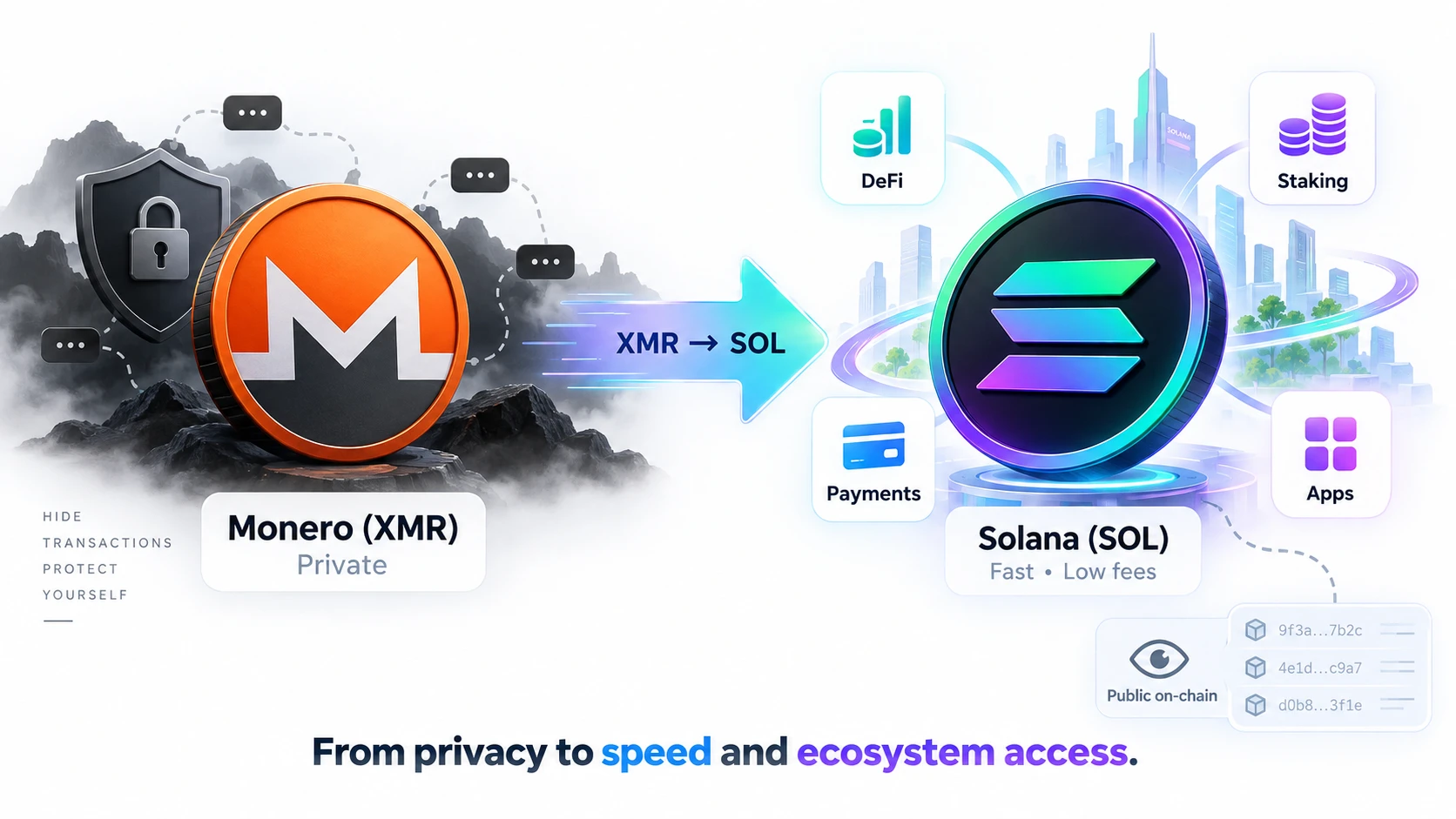
Solana (SOL) is a high-throughput public blockchain optimised for speed, low fees and a large application ecosystem that includes DeFi, NFTs, payments and consumer apps.
Users move from XMR to SOL for several practical reasons:
- Accessing Solana DeFi, staking or application ecosystems
- Converting XMR into an asset widely integrated across the Solana ecosystem
- Preparing funds for fast, low-cost transfers on Solana
- Rebalancing a portfolio after using Monero for privacy-sensitive transfers
The trade-off is clear: leaving Monero means moving value onto a transparent ledger.
Once SOL arrives at a public address, subsequent activity on that address is visible on-chain.
Why XMR to SOL Is a Rare Direction
Most major centralized exchanges either delisted Monero or never supported it broadly.
At the same time, pure Solana DEXs cannot natively accept XMR because Monero is a separate privacy-focused chain with no direct smart-contract bridge into Solana’s account model.
As a result:
- Direct XMR/SOL order books on large CEXs are uncommon or unavailable
- Atomic-swap tooling between XMR and SOL remains limited compared with BTC–XMR routes
-
The practical path for most users is a non-custodial instant swap service that sources liquidity and handles the cross-chain conversion
This scarcity is exactly why checking live pair availability matters.
A service may list both XMR and SOL in its coin catalogue yet still lack a reliable direct route, or it may route through intermediate assets.
Always confirm the specific pair in the interface before sending funds.
Which Services Support XMR to SOL?
Support changes over time.
In 2026 the main category that still surfaces Monero-related routes is non-custodial instant swap and aggregator services.
Examples often discussed for XMR routes include Quickex, StealthEX, Godex, ChangeNOW and similar platforms, as well as rate aggregators such as Trocador, Swapzone and SwapSpace.
Important caveat: support for Monero in general does not automatically mean support for the specific pair XMR → SOL.
Liquidity for privacy-to-public routes is thinner than for major pairs, so the same service may show the pair at one moment and temporarily lack competitive depth at another.
As of September 2026, Quickex lists an XMR → SOL route.
Users can swap XMR to SOL through an accountless flow when the pair is offered in the live interface.
Always verify before sending funds:
- Whether XMR → SOL appears as a selectable pair
- The quoted receive amount
- Minimums and any network notes
-
Whether the rate is fixed or floating
How Long Does an XMR to SOL Swap Take?
Total time is the sum of three parts:
1. Monero Deposit Confirmations
Monero has an approximate two-minute block target.
Many wallets treat newly received funds as unlocked after 10 confirmations. Monero produces a block approximately every two minutes, and newly received XMR normally becomes spendable after 10 confirmations. A swap provider may apply a different deposit-confirmation threshold, which should be checked separately in the order interface.
2. Service Processing / Routing
Once the deposit is accepted as sufficiently confirmed, the service converts and prepares the Solana side.
Duration depends on liquidity and internal handling.
3. Solana Settlement
Once the provider broadcasts the SOL transfer, Solana network confirmation is typically much faster than the Monero side, although actual delivery still depends on provider and network conditions.
Practical Expectation
Under normal conditions, total completion is often measured in tens of minutes rather than seconds, with the Monero confirmation window as the main contributor.
Congestion, risk-based review or thin liquidity can extend the timeline.
Always treat any published range as approximate and check the service’s own estimate when placing the order.
How the Swap Actually Works
On a typical non-custodial instant swap service the flow is:
- User selects XMR as the sending asset and SOL as the receiving asset.
- The interface shows a live quote, fixed or floating.
- User pastes a Solana receiving address, for example from Phantom, Solflare or another Solana wallet.
- User sends the exact amount of XMR to the one-time deposit address provided.
- After the required Monero confirmations and service processing, SOL is delivered to the specified address.
The user does not need to open an account for a standard order.
Funds are under temporary control only during processing; after completion nothing remains on the platform under the user’s name.
Fixed vs Floating Rates on This Pair
Fixed Rate
Locks the amount of SOL you will receive for a limited time.
A fixed quote protects the displayed receive amount during the provider’s stated payment window, subject to its expiry and rate-adjustment rules.
Floating Rate
Tracks the market more closely.
The final SOL amount can change between the moment you see the quote and the moment the deposit is detected and converted.
Because XMR/SOL is a thinner pair than major routes, spreads can be wider and liquidity more variable.
Comparing the net SOL received for the same XMR input across services, and across fixed vs floating, is more informative than looking at a headline rate alone.
What Affects the Rate You Get
- Live market prices of XMR and SOL
- Available liquidity for the specific route
- Whether the service uses a direct path or intermediate hops
- Fixed vs floating selection
- Order size relative to available depth
-
Temporary market volatility during the Monero confirmation window
There is no permanent “best rate” provider for this pair.
The only reliable method is to check live quotes at the time you intend to swap.
Step-by-Step: How to Swap XMR to SOL
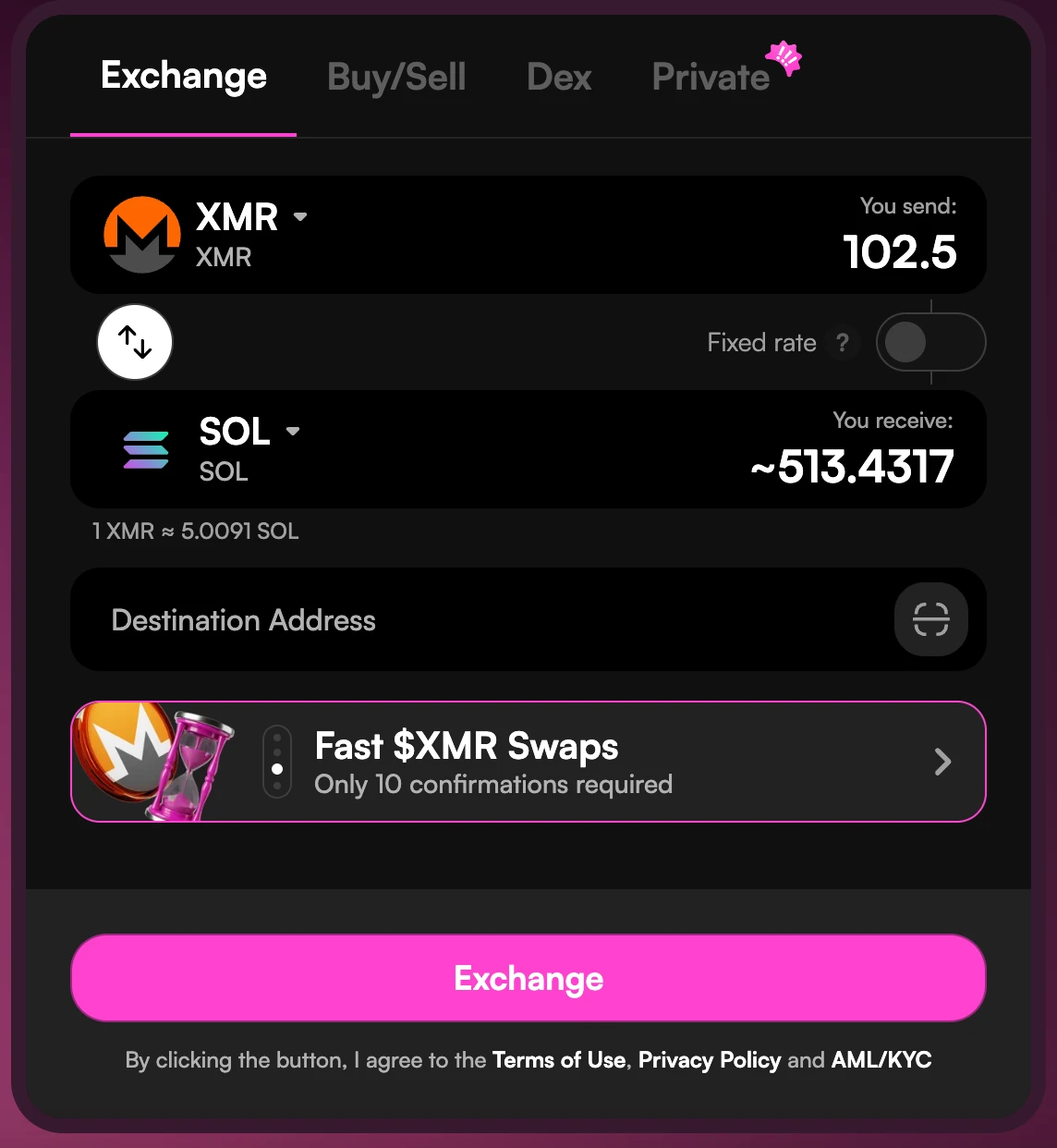
- Open a non-custodial swap interface that lists the pair.
- Select XMR → SOL.
- Enter the amount of Monero you wish to send.
- Review the quoted SOL amount and choose fixed or floating rate.
- Paste a Solana address you control. Double-check it.
- Confirm the order and send the exact XMR amount to the deposit address shown.
- Wait for the required Monero confirmations and for the service to process the order.
- Receive SOL in your Solana wallet.
Privacy Considerations When Leaving Monero
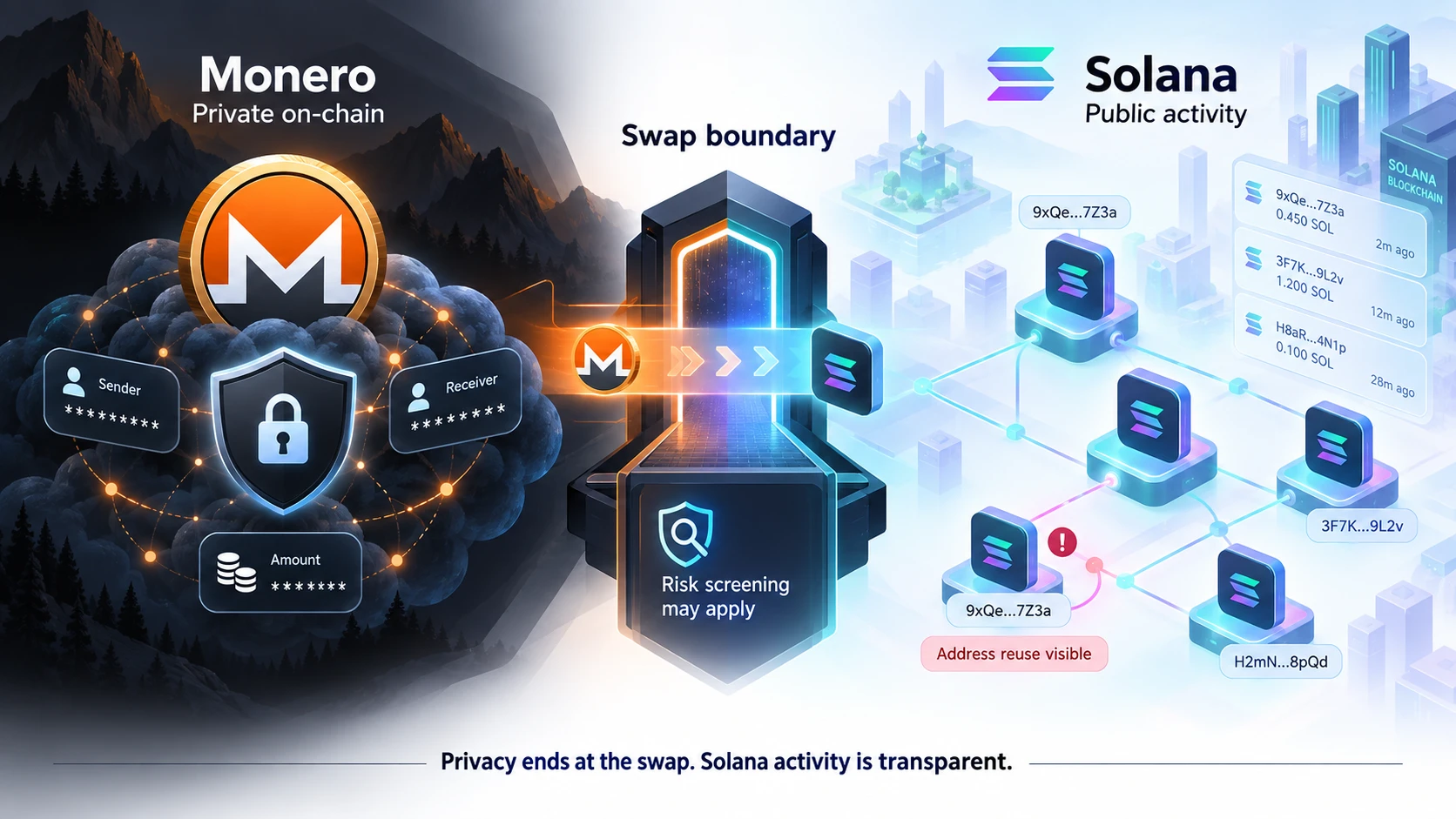
Monero obscures sender, receiver and amount on-chain.
Solana does not.
Once value reaches Solana, subsequent activity on the receiving address becomes publicly visible on-chain.
Monero’s native on-chain privacy protections no longer apply to the Solana side.
Practical implications:
- Address reuse on Solana can create visible links between activity
- The conversion itself is the boundary between Monero’s private ledger and Solana’s public ledger
-
Swap services and their liquidity providers may still apply risk-based monitoring even when no account is required
Using a receiving address you control and understanding that Solana activity is transparent are the core points.
Further operational choices depend on the user’s own threat model and should not be treated as universal advice.
Risks and Practical Checks
- Pair availability — the route may not always be offered or may have poor depth
- Monero confirmation time — plan for a window measured in tens of minutes
- Address errors — irreversible on both chains
- Rate movement — especially on floating quotes during the confirmation window
- Risk-based screening — flagged deposits can be delayed even on accountless services
-
Liquidity risk — thinner pairs can show wider spreads or temporary unavailability
Before sending XMR:
- Confirm the pair is available and the quote is acceptable
- Verify the Solana receiving address
- Note any stated confirmation requirement and the service’s time estimate
-
Start with a small test amount if using a service or the pair for the first time
Conclusion
Moving from Monero into the Solana ecosystem is possible, but XMR to SOL remains a relatively rare direct direction.
Centralized order books are limited, a widely used direct native bridge between Monero and Solana is not generally available, and the practical path for most users is a non-custodial instant swap service that can source the route.
Settlement time is driven mainly by Monero confirmations.
Rates should be compared live, privacy expectations should be adjusted once value reaches Solana, and small test amounts remain the safest way to validate a new service or pair.
As of September 2026, when the route is available, users canswap XMR to SOL through an accountless interface and receive SOL directly in a wallet they control.
Always re-check pair availability, minimums and the quoted receive amount immediately before sending Monero.
Pair support, confirmation behaviour and processing times reflect commonly observed instant-swap patterns and public network characteristics as of September 2026.
Conditions change — verify everything in the live interface before transacting.
FAQ
How Do I Swap XMR to SOL?
You can swap XMR to SOL through non-custodial instant swap services that list the pair: select XMR → SOL, provide a Solana address, send Monero to the deposit address, and wait for confirmations and processing.
Always check live availability and the net SOL amount before sending.
Why Is XMR to SOL Harder to Find than Other Pairs?
Monero has been removed from many centralized exchanges, and there is no native on-chain bridge into Solana.
Most practical routes therefore rely on instant swap services that source cross-chain liquidity.
How Long Does an XMR to SOL Swap Take?
Total time is usually dominated by Monero confirmations and is often measured in tens of minutes under normal conditions.
Exact duration depends on the provider’s confirmation policy, network conditions and processing.
Do I Need an Account or KYC?
Standard orders on non-custodial instant swap services generally do not require registration or mandatory KYC.
Risk-based screening can still apply to individual deposits.
How Can I Get the Best XMR to SOL Rate?
Compare live quotes for the same amount across services that support the pair, and look at the net SOL received rather than a headline rate.
Fixed and floating options can also differ.
Is the Solana Side Private?
No, activity on the Solana receiving address is publicly visible on-chain.
Monero’s native privacy protections do not extend to the Solana side after conversion.