


A Bitcoin ETF Can Give You the Price. It Can't Give You Bitcoin

Image: Here
Bitcoin ETFs have made price exposure easier to fit into a conventional portfolio. For investors who want an instrument that can sit beside equities, bonds, and other funds, that convenience matters. Yet the growth of these products has also made an older distinction more important: tracking Bitcoin’s market value is not the same thing as possessing an asset that can move through the Bitcoin network.
That difference can disappear when attention is fixed on performance charts. An ETF may rise and fall closely with Bitcoin, giving its holder much of the same market exposure. But the investor owns a fund share rather than a spendable balance controlled by a Bitcoin private key. The distinction becomes visible as soon as Bitcoin is used rather than simply priced.
What the Crypto Gaming Site Reveals About Usable Bitcoin
One practical way to see the distinction is to consider how Bitcoin works inside an application that actually accepts the asset. Some of the best crypto poker sites, that have been in the demanding market long enough, have demonstrated the value of crypto in gaming operations. One comparing the crypto site is not only looking at the displayed value of Bitcoin. The important mechanics begin when funds move from a wallet into an account and continue when winnings or balances are withdrawn again.
A native Bitcoin deposit involves several distinct steps:
|
Is Poker With Crypto Actually Different? Crypto poker is not a different version of poker in terms of how the game itself works. The rules, hand rankings, betting rounds, table formats, and win conditions remain the same as they would in a conventional online poker game. A pair still beats a high card, a flush still beats a straight, and players make the same strategic decisions about when to bet, call, raise, or fold. The difference is mainly in the payment layer. Instead of funding an account with a card, bank transfer, or another conventional payment method, players can deposit Bitcoin and, where supported, withdraw their balance in Bitcoin as well. The same applies to a poker bankroll: players still need to decide how much of their available balance to put into games and how to manage that balance over time, regardless of whether it is denominated in Bitcoin or conventional currency. Please embed the video: https://youtube.com/shorts/DzM75YS2Bls?si=S3_xMnI_5zu1dU7oThe game engine still handles cards, wagers, pots, and results in the usual way; Bitcoin simply provides the means of moving value into and out of the account. |
So, examining crypto gaming platforms provides a useful case for the broader ETF discussion. The contrast is functional rather than ideological. An ETF is designed to package investment exposure. Native Bitcoin is designed to be transferable through its own network.
For an investor interested only in price movement, that difference may have little day-to-day importance. For anyone who wants to use Bitcoin within digital services, transfer value between wallets, or hold an asset under direct cryptographic control, it becomes central.
Price Exposure and Network Ownership Serve Different Purposes
The scale of ETF adoption shows how valuable packaged exposure has become. A tracker covering 13 U.S. Bitcoin ETFs reported that they collectively held about 1.268 million BTC on September 9, 2026, worth roughly $97.7 billion at the time. That represented about 6.04% of Bitcoin’s fixed 21 million-coin maximum supply.
Those holdings demonstrate substantial demand, but they also help clarify what an ETF investor actually owns. The underlying Bitcoin may sit inside the fund structure, while the investor holds shares whose economic value is linked to those assets.
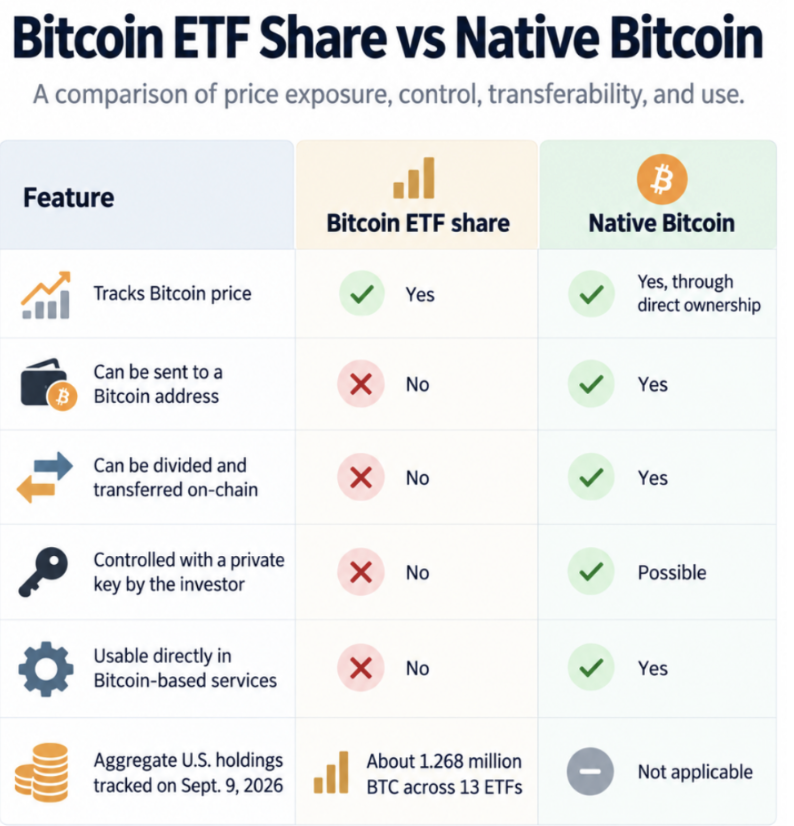
Original visual material, created by us.
This creates two different forms of utility. ETF investors gain a familiar portfolio instrument and can measure returns alongside other financial assets. Native holders gain access to Bitcoin’s transaction layer.
The distinction also explains why ETF demand should not be treated as a replacement for on-chain activity. The two can grow together because they answer different needs. One packages Bitcoin as investable exposure; the other preserves Bitcoin as a transferable digital asset. For a market that increasingly includes both institutional allocation and direct digital ownership, understanding that separation is more useful than treating one format as a substitute for the other.
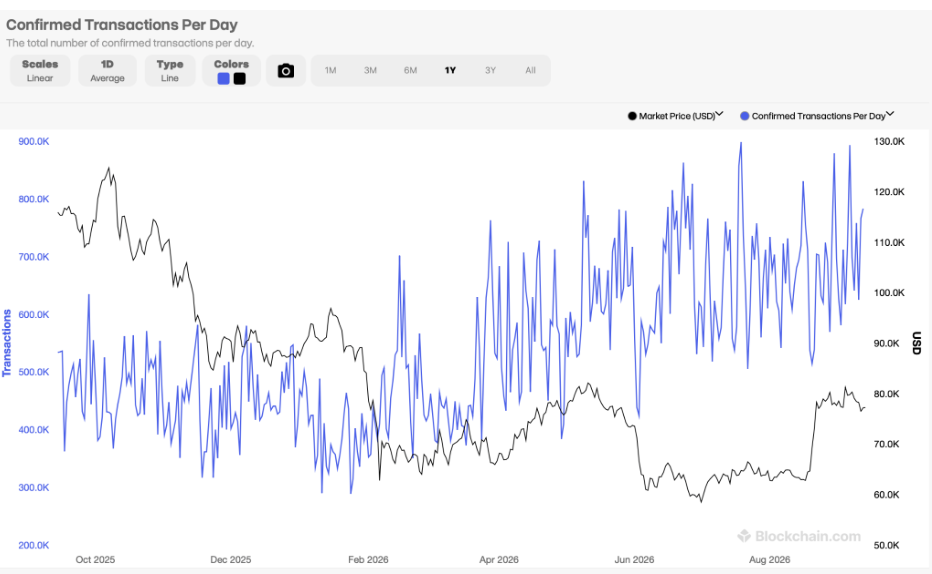
Data shows Bitcoin processing hundreds of thousands of confirmed transactions each day throughout the past year, with activity reaching several notable peaks in 2026.
Source: Here
Bitcoin’s Network Utility Exists Beyond Its Market Price
Bitcoin’s original design makes the ownership distinction especially clear. In the white paper, Satoshi Nakamoto wrote, “We define an electronic coin as a chain of digital signatures.” The point is technical but still relevant: Bitcoin ownership is expressed through the ability to authorize transfers, not merely through financial exposure to changes in its quoted price.
Current network activity shows that this function remains active at large scale. Bitcoin processed 625,497 transactions on September 10, 2026, after recording more than 893,000 on September 6.
Those numbers do not tell investors which form of exposure will produce better returns. They show something more basic: the asset continues to perform work as part of a network independently of the investment products built around its price.
Direct ownership adds a second layer of utility
That distinction may become more important as Bitcoin finance develops. Portfolio products can make market exposure simpler, while wallets, payment tools, and digital applications can expand the reasons someone might want directly transferable Bitcoin. These are complementary paths rather than identical ones.
A Bitcoin ETF can therefore represent Bitcoin very effectively as a financial price. Native Bitcoin adds another layer: possession of an asset that can participate in the network itself.
So practically, investors should distinguish between wanting Bitcoin’s market performance and wanting Bitcoin’s actual network capabilities, because only direct ownership can provide both.